 English
  Español
  français
  العربية
 Search
Search
Modern skincare needs more than a short-lived moisturizing effect. Formulators increasingly seek ingredients that support hydration, barrier-care concepts, and products designed for everyday environmental exposure. Ectoine is relevant because microorganisms use it to remain stable in dry, saline, hot, or otherwise stressful surroundings.
Today, ectoine is found in moisturizers, serums, barrier-care products, hair and scalp formulas, and selected biotechnology applications. Its value comes from the way it interacts with water and helps maintain the stability of biological structures.
This guide explains what ectoine is, its main skincare and biotechnology applications, and what buyers should know about CAS 96702-03-3.
Ectoine is a naturally occurring cyclic amino acid derivative and compatible solute that helps microorganisms maintain cellular stability under osmotic and environmental stress.
Salt-tolerant microorganisms accumulate ectoine to balance osmotic pressure without interrupting their normal cellular processes. In practical terms, the molecule helps create a stable water environment around proteins, membranes, and other biological structures.
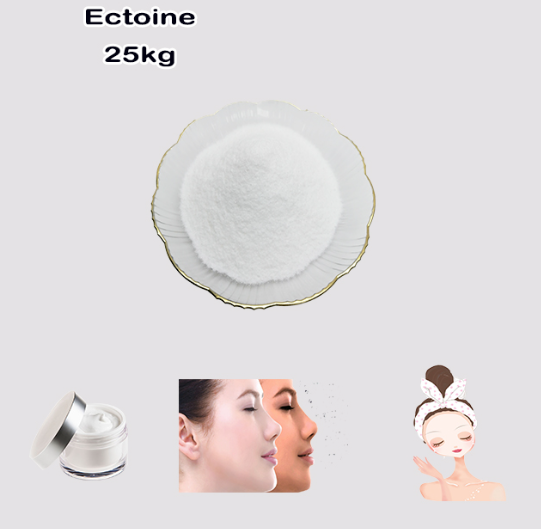
PubChem identifies ectoine as CAS 96702-03-3, with the molecular formula C6H10N2O2 and a molecular weight of 142.16 g/mol. It is generally described as a white, water-soluble powder.
Ectoine is commonly explained through a process known as preferential hydration. It influences the organization of nearby water molecules, creating a hydrated environment around proteins and cell membranes.
Three characteristics help explain why ectoine is relevant to cosmetic and biotechnology development:
It supports water organization around biological structures.
It functions as an osmoprotective compatible solute in microorganisms.
It can complement other moisturizing and barrier-support ingredients in a finished formula.
For this reason, ectoine is often described as an extremolyte—a protective molecule associated with organisms that survive demanding environmental conditions.
| Chemical identity | Reference information |
| Ingredient name | Ectoine |
| CAS number | 96702-03-3 |
| Molecular formula | C6H10N2O2 |
| Molecular weight | 142.16 g/mol |
| General appearance | White powder |
| General solubility | Soluble in water |
Ectoine can support hydration, barrier-focused formulations, and products developed for everyday environmental stress. Performance still depends on the complete formula, including its emollients, occlusive ingredients, pH, preservation system, and packaging.
Dryness is often linked to both low water content and a weakened skin barrier. Ectoine can help maintain a hydrated microenvironment around skin-related biological structures.
In practical formulation work, ectoine is usually more valuable when combined with other moisturizing ingredients. Humectants help attract or retain water, emollients improve softness, barrier lipids support the stratum corneum, and occlusive ingredients help reduce water loss.
Ectoine can complement this system rather than being expected to perform every moisturizing function alone.
A systematic review published through the U.S. National Library of Medicine examined topical ectoine-containing formulations used for skin conditions associated with an impaired barrier. The review reported encouraging findings related to dryness, redness, and other symptoms, while noting that the evaluated products were complete formulations rather than ectoine alone.
This distinction is important for responsible cosmetic communication. Ectoine can be described as a supportive skincare ingredient, but it should not be presented as a medical treatment or a guaranteed solution for a skin condition.
Ectoine has also been studied in connection with ultraviolet-related cellular stress and the stability of proteins, membranes, and DNA. This scientific background supports its use in environmental-care, anti-pollution, and after-sun formulation concepts.
However, ectoine is not a UV filter. It cannot replace approved sunscreen filters, appropriate SPF testing, or a properly designed sun-protection system.
For skincare development, its most practical benefits include:
Supporting moisture retention and a comfortable skin feel.
Complementing barrier-care formulas for dry or sensitive-feeling skin.
Helping protect biological structures from dehydration-related stress.
Supporting products designed for environmental-care positioning.
Adding multifunctional value without relying on aggressive claims.
The main ectoine uses extend from daily skincare to personal care and biotechnology. Although its role varies by application, hydration management and structural stability remain common themes.
Ectoine can be incorporated into hydrating serums, moisturizers, barrier creams, facial masks, eye-area products, and body-care formulas.
It is particularly relevant to products developed around:
Dry or dehydrated skin
Sensitive-feeling skin
Skin barrier support
After-sun comfort
Urban environmental exposure
Daily moisturizing care
In sun-care products, ectoine may be included as a supporting skincare ingredient. It can contribute to a formula designed to maintain hydration and comfort, but SPF and UVA claims must come from compliant UV filters and suitable finished-product testing.
Hair and scalp formulas may use ectoine where moisture balance and comfort are important. Potential applications include shampoos, conditioners, scalp serums, leave-in treatments, and products intended for dry-feeling hair or scalp.
Compatibility must still be evaluated in the actual formulation. A raw material that is soluble in water does not automatically remain stable in every surfactant, polymer, fragrance, or preservation system.
In biotechnology, ectoine is studied as a valuable microbial metabolite that may help stabilize proteins, membranes, cells, and other biomolecules exposed to salinity, temperature changes, drying, or processing stress.
Research also covers microbial fermentation, metabolic engineering, and the development of more efficient ectoine production processes. These areas make ectoine relevant beyond finished cosmetics, particularly where the stability of biological materials is important.
| Application area | Why ectoine is considered | Important note |
| Moisturizers and serums | Supports hydration and barrier-care positioning | Evaluate performance in the complete formula |
| Sensitive-skin products | Supports comfort-focused formulations | Avoid unsupported medical claims |
| Sun-care support | Relevant to environmental-stress concepts | Does not replace approved UV filters |
| Hair and scalp care | Supports moisture-management concepts | Test compatibility with the full system |
| Biotechnology | Studied for biomolecule and cellular stability | Requirements depend on the process and end use |
At Fortunachem, we supply Ectoine CAS 96702-03-3 as a white powder for customers developing skincare, personal-care, and other qualified applications.
Our standard product specification sets chemical purity at more than 97.00% by HPLC area. The listed test result is 97.3%.
Our Ectoine CAS 96702-03-3 specification includes:
White-powder appearance
Solubility in water and alcohol
Identification by ¹H NMR in D2O
Specific rotation of [α]D25 = 17° ± 0.2 under the stated test conditions
A listed specific-rotation result of +17.1°
Standard packages of 1 kg per foil bag and 25 kg per drum
These values describe our standard product profile. Because analytical results are batch-specific, customers should refer to the certificate of analysis provided for the supplied batch.
Our team can also confirm current packaging availability, order requirements, shipping conditions, and available technical documentation during the inquiry process.
Selecting ectoine involves more than comparing a single purity figure. The product specification, supporting documents, packaging, and supply conditions should all match the intended formulation and target market.
Before placing an order, buyers should confirm:
The current batch COA, identity tests, assay method, and purity result.
Technical and safety documents required for the destination market.
Packaging size, order quantity, storage, and shipping conditions.
Suitability for the intended cosmetic, personal-care, or biotechnology use.
Compatibility and stability in the final formulation.
Product developers should conduct their own formulation, stability, compatibility, and regulatory assessments before commercial production.For specifications, packaging information, samples, or a quotation, visit our Ectoine CAS 96702-03-3 product page.
Ectoine is a compatible solute used in hydration, barrier-care, environmental-care, and biotechnology concepts. It works best within a well-designed and properly tested formulation. Fortunachem supplies Ectoine CAS 96702-03-3 with defined specifications and bulk packaging options for qualified buyers seeking reliable sourcing and product support.
Yes. “Ectoine” is the standard spelling used by PubChem and many scientific publications, while “ectoin” is also found in commercial and consumer-facing content. CAS 96702-03-3 can be used to confirm the chemical identity.
Common ectoine uses include hydrating serums, moisturizers, barrier creams, facial masks, eye-area products, sensitive-skin formulas, and supporting ingredients in sun-care or after-sun products.
Ectoine is a hydration-support ingredient. Its interaction with surrounding water helps maintain a hydrated environment around biological structures. However, the moisturizing performance of a finished product depends on the complete formulation.
Not necessarily. Ectoine and hyaluronic acid have different structures and formulation roles. They may be used together when a formulator wants to combine conventional humectant performance with ectoine’s hydration and stress-protection positioning.
Research has examined ectoine in relation to UV-associated cellular stress and DNA protection. Cosmetic claims should remain supportive and should not imply that ectoine treats UV injury or replaces sunscreen. Effective sun protection requires approved UV filters and appropriate finished-product testing.
Our standard specification requires more than 97.00% chemical purity by HPLC area. The listed test result is 97.3%. Customers should confirm the actual result through the certificate of analysis supplied for their batch.
Fortunachem offers standard packaging of 1 kg per foil bag and 25 kg per drum. Packaging availability and shipping conditions should be confirmed when requesting a quotation.

Quick Links
Add:
E-mail:
 中文
中文