 English
  Español
  français
  العربية
 Search
Search
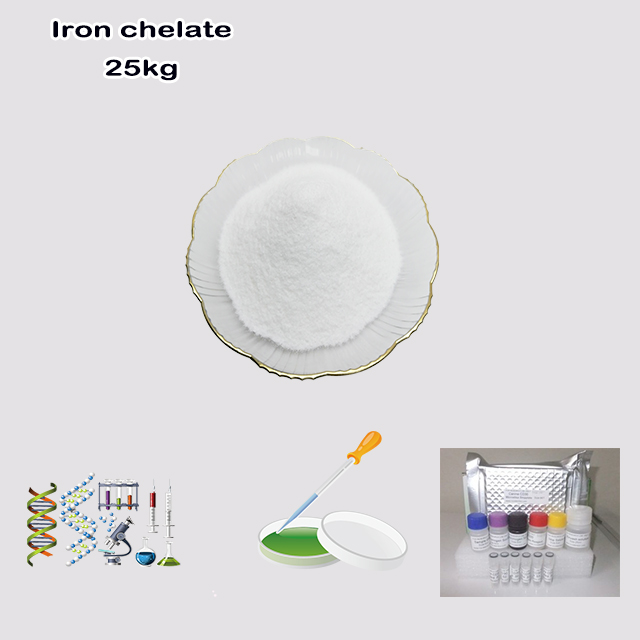
Iron chelate, in chemical terms, is a stable complex where an iron ion (Fe²⁺ or Fe³⁺) is bound by an organic ligand (like EDTA) via multiple bonds, forming a claw-like structure. This prevents precipitation and controls the iron's reactivity.
Its primary chemical uses are:
Analytical Reagent: As a colorimetric agent (e.g., with phenanthroline) for spectrophotometric iron analysis or as a masking agent in titrations.
Catalyst: Employed in controlled oxidation processes, such as Fenton-like reactions for degrading organic pollutants in water.
Research Standard: A precise source of bioavailable iron in biochemical studies and a precursor for synthesizing iron-containing nanomaterials.
In essence, it is a specialized reagent for analysis, catalysis, and controlled reactivity in the lab.
Items | Specifications | Results |
Fe | ≥20% | 20.5% |
Protein | ≥15% | 18.6% |
Vitamin E | ≥5 mg/kg | 5.7 mg/kg |
Vitamin D3 | ≥2000 IU/kg | 2080 IU/kg |
Salmonella | May not be detected | Without |
To other bacteria | May not be detected | Without |
Arsenic (As a total) | ≤5 ppm | <3 ppm |
Lead (pb in total) | ≤20 ppm | <10 ppm |
Conclusion | The product conforms to the above specifications. | |
In chemistry, an iron chelate is a complex compound in which an iron ion (Fe²⁺ or Fe³⁺) is tightly bound to a chelating agent or ligand via multiple coordinate covalent bonds. The term "chelate" comes from the Greek word for "claw"—the ligand encircles and grasps the metal ion in a ring-like structure.
This chelation dramatically alters the properties of the free iron ion:
Prevents Precipitation: It keeps iron soluble and stable in aqueous solutions, especially at neutral or alkaline pH where free iron would normally form insoluble oxides/hydroxides (rust).
Modifies Reactivity: It controls the redox potential (ease of gaining/losing electrons) and chemical reactivity of the iron center.
Provides Defined Structure: Creates a specific molecular environment around the iron.
Common Chelating Agents used for Iron:
EDTA (Ethylenediaminetetraacetic acid): Forms a very strong, hexadentate (6-bond) complex. Common in lab reagents.
DTPA (Diethylenetriaminepentaacetic acid): Similar to EDTA but with higher affinity and stability.
Citrate: A weaker, naturally occurring chelator.
o-Phenanthroline, Bipyridine: Form intensely colored complexes, useful in analysis.
HEDTA, EDDHA, Gluconate: Used in specialized industrial and agricultural formulations.
Chemical-grade iron chelates are employed as precise reagents and catalysts. Here are the key uses:
1. Analytical Chemistry:
Colorimetric Reagents: Certain iron chelates are intensely colored and used for quantitative analysis.
Example: Ferrozine and 1,10-phenanthroline form deep red/pink complexes with Fe²⁺. This allows for sensitive spectrophotometric measurement of iron concentration in water, biological samples, or industrial solutions.
Example: Ferric thiocyanate complex is used to test for the presence of phenols or peroxides.
Masking Agents: EDTA is used to chelate and mask interfering metal ions (like iron) in complexometric titrations or other analyses, preventing them from reacting.
2. Catalyst in Chemical Reactions & Research:
Iron chelates are pivotal in studying and catalyzing oxidation reactions due to their controlled redox activity.
Fenton and Fenton-like Reactions: Chelated iron (often Fe-EDTA) is used as a soluble catalyst for the generation of highly reactive hydroxyl radicals (•OH) from hydrogen peroxide. This is studied for:
Advanced Oxidation Processes (AOPs): For degrading organic pollutants in wastewater.
Biochemical Research: To study oxidative stress and radical damage in model systems.
Polymerization Catalysts: Some iron chelates act as catalysts or catalyst components in the production of polymers.
Organic Synthesis: Used as Lewis acid catalysts or in oxidation reactions where a specific iron redox state must be maintained.
3. Reagent in Material Science & Nanotechnology:
Precursor for Iron-Containing Materials: Iron chelates can be used as molecular precursors to deposit iron oxide films or create nanomaterials through controlled thermal decomposition (Chemical Vapor Deposition or sol-gel processes).
Model Compounds for Biological Systems: Synthetic iron chelates are used to model the active sites of iron-containing enzymes (e.g., peroxidases, oxygenases) to study their structure and function.
4. Standard Solutions and Buffer Additives:
Trace Metal Studies: A precisely prepared Fe-EDTA standard solution is used to calibrate instruments (like ICP-MS or AAS) and spike samples in trace metal analysis.
Biological Buffers: In laboratory cell culture and biochemistry, Transferrin (a natural iron chelating protein) or simple chelates like ferric citrate are used to deliver bioavailable iron to cells in a controlled, non-toxic manner, preventing iron-catalyzed free radical damage.
5. Industrial Process Chemistry:
Scrubbing Gases: Iron chelate solutions (e.g., Fe-EDTA) are used to remove harmful gases like hydrogen sulfide (H₂S) from gas streams in a process called "chemi-sorption," where the chelated iron catalyzes the oxidation of H₂S to elemental sulfur.
| Feature | Chemical / Research Grade | Agricultural / Horticultural Grade |
|---|---|---|
| Purity | Very high (≥95-99.9%), well-defined composition. | Lower, contains stabilizers and fillers. |
| Purpose | Reagent, catalyst, analytical standard, research. | Soil/foliar fertilizer to treat iron chlorosis in plants. |
| Chelator | Often simple (EDTA, Citrate) for defined chemistry. | Engineered for soil stability (EDDHA, EDDHMA, DTPA). |
| Cost | Higher per unit weight. | Lower, sold in bulk. |
Stability: Chelated iron is generally more stable and less prone to causing catalytic oxidative damage than free iron salts, but it still requires careful handling.
Environmental: While used to treat pollution, large quantities of synthetic chelates like EDTA are poorly biodegradable and can remobilize toxic heavy metals in the environment.
Laboratory Use: Standard lab safety applies—avoid inhalation of dust, contact with eyes/skin, and consult the specific Safety Data Sheet (SDS).
In chemical terms, iron chelate is a versatile tool and reagent where the chelating ligand is chosen to give the iron center specific solubility, stability, redox potential, and reactivity. Its primary uses are in analytical chemistry as a reagent or mask, as a controlled catalyst in oxidation reactions, in material synthesis, and as a standardized source of iron for research and industrial processes.

Fortunachem Provides Not Only Professional Chemical Products But Also Professional Help
Keeping you up-to-date with all the latest information, news, and events about Fortunachem!


Quick Links
Add:
E-mail:
 中文
中文