 English
  Español
  français
  العربية
 Search
Search
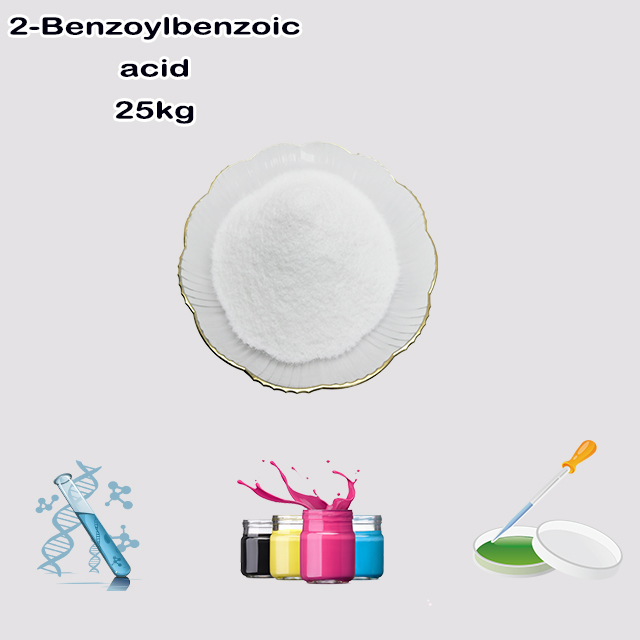
2-Benzoylbenzoic acid (C₁₄H₁₀O₃) is an organic compound featuring a benzoic acid group and an ortho-positioned benzoyl group on a benzene ring. It appears as a white crystalline solid, moderately soluble in hot organic solvents. Its primary use is as a key intermediate in the synthesis of anthraquinone—achieved through acid-catalyzed intramolecular Friedel–Crafts acylation. Anthraquinone is vital in manufacturing vat dyes and pigments known for excellent lightfastness. Additionally, 2-benzoylbenzoic acid serves as a building block in pharmaceutical research and organic synthesis, enabling the construction of heterocyclic compounds due to its dual functional groups (ketone and carboxylic acid). It can be derivatized into esters, amides, or acid chlorides for further reactions. While useful, it should be handled with care, using proper protective equipment to avoid irritation. Overall, this compound bridges fine chemical production and industrial dye chemistry.
2-Benzoylbenzoic acid (also known as o-benzoylbenzoic acid) is an organic compound with the molecular formula C₁₄H₁₀O₃. It consists of a benzoic acid group (–COOH) attached to a benzene ring that also carries a benzoyl group (–COC₆H₅) at the ortho position (position 2).
Chemical Structure:
IUPAC Name: 2-Benzoylbenzoic acid
Molecular Formula: C₁₄H₁₀O₃
Molar Mass: ~226.23 g/mol
Structure: A benzene ring with a carboxylic acid (–COOH) at carbon 1 and a benzoyl (–COC₆H₅) group at carbon 2.
Key Properties:
White to off-white crystalline solid
Moderately soluble in hot organic solvents (e.g., ethanol, acetone), less soluble in water
Can undergo typical reactions of both aromatic ketones and carboxylic acids
Main Uses in Chemistry:
1.Precursor to Anthraquinone:
The most important industrial use of 2-benzoylbenzoic acid is as an intermediate in the synthesis of anthraquinone.
Under acidic conditions (e.g., concentrated H₂SO₄), it undergoes intramolecular Friedel–Crafts acylation (cyclization) to form anthraquinone, a key compound in dye manufacturing.
2.Dye and Pigment Industry:
Since anthraquinone derivatives are widely used as vat dyes (e.g., alizarin, indanthrone), 2-benzoylbenzoic acid indirectly supports the production of high-quality, lightfast dyes for textiles.
3.Pharmaceutical Intermediates:
Used in the synthesis of certain bioactive molecules and drug candidates due to its bifunctional nature (ketone + carboxylic acid), enabling diverse derivatization.
4.Organic Synthesis Building Block:
Serves as a substrate for preparing heterocyclic compounds (e.g., phenanthridines, xanthenes) via cyclization or condensation reactions.
Can be converted to acid chlorides, esters, or amides for further functionalization.
5.Research Applications:
Employed in studies of electrophilic aromatic substitution, intramolecular cyclizations, and photochemical behavior of aromatic ketones.
Safety Note:
Like many aromatic compounds, 2-benzoylbenzoic acid should be handled with care—use appropriate PPE (gloves, goggles) and work in a fume hood. It may cause irritation to skin, eyes, or respiratory tract.
In summary, 2-benzoylbenzoic acid is primarily valued as a key intermediate in anthraquinone synthesis, which underpins its importance in the dye, pigment, and fine chemical industries

Fortunachem Provides Not Only Professional Chemical Products But Also Professional Help
Keeping you up-to-date with all the latest information, news, and events about Fortunachem!


Quick Links
Add:
E-mail:
 中文
中文