 English
 Español
 français
 العربية
 中文
Urea supports hydration and, depending on concentration, helps soften thickened surface skin. Its use in a body lotion can therefore differ from its role in a targeted foot-care product.
For manufacturers, choosing urea means connecting the intended skin benefit with a workable formulation and a documented raw-material specification. This guide explains those decisions, from moisturizing applications to pharmaceutical-grade selection.
What Is Urea as a Skincare Ingredient?
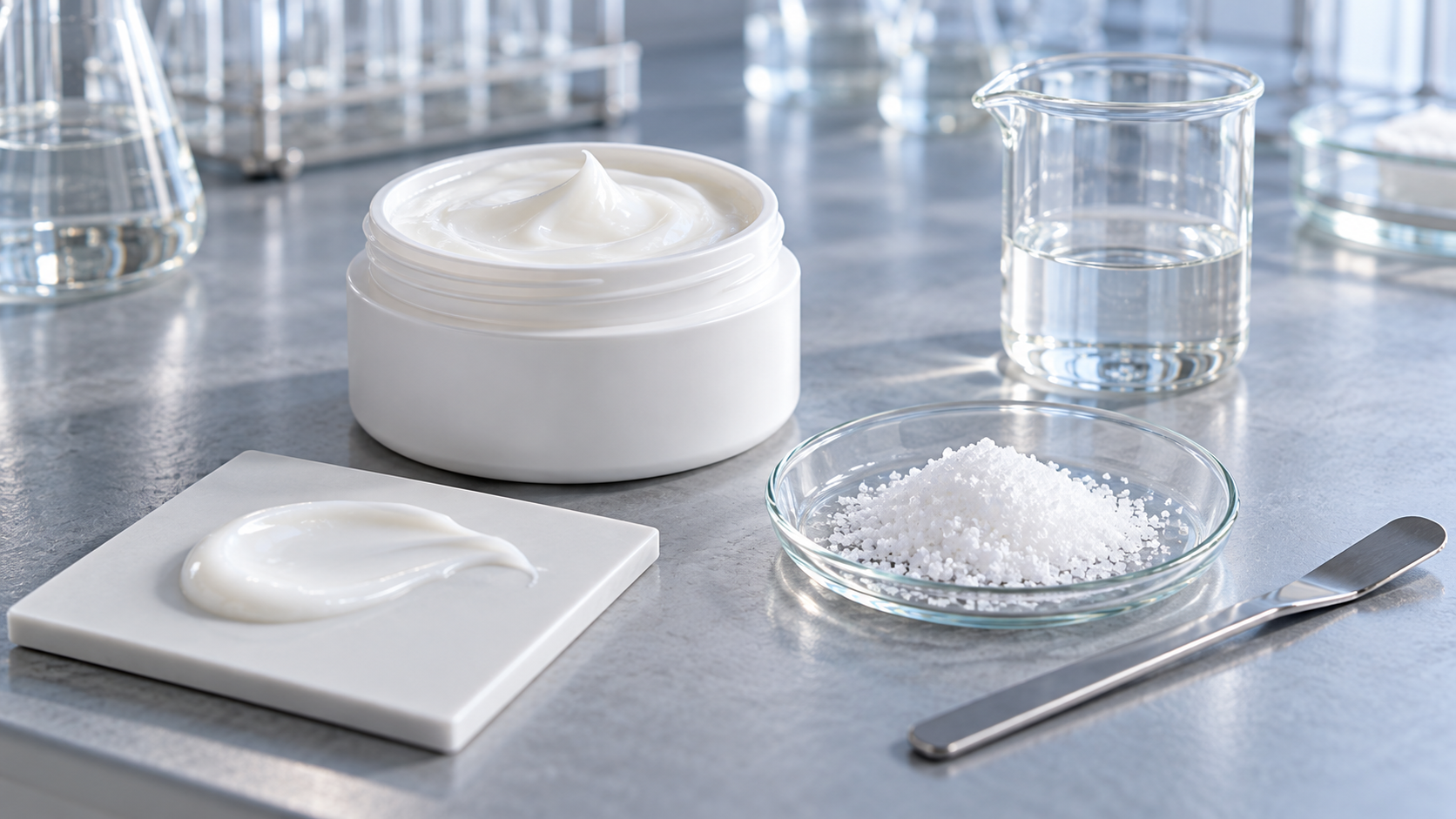
Urea is also known as carbamide and has CAS number 57-13-6, as identified in the United States Pharmacopeia monograph. It is part of the skin's natural moisturizing factor, which helps maintain hydration in the outermost skin layer.
For a urea skincare ingredient, chemical identity is only the beginning of qualification. Buyers also need to establish the material's grade, impurity controls and suitability for the intended application.
Distinguish raw-material assay from finished-product concentration. The assay describes the supplied ingredient under a specified analytical method. The formulation concentration describes how much urea is incorporated into the cream or lotion. Confusing them can lead to an unsuitable purchase specification.
What Are the Benefits of Urea in Skincare?
As a humectant, urea helps the outer skin layer retain water. Its keratolytic action at higher concentrations involves changes to keratin, the protein associated with the skin's surface structure.
These roles explain why concentration matters. A published dermatology review groups topical urea formulations as follows:
| Concentration range in the review | Reported role | Development consideration |
| 2%–10% | Moisturization and barrier support | Evaluate hydration and everyday product acceptability |
| 10%–30% | Moisturization and keratolytic activity | Balance the intended effect with tolerability |
| 30% or above | More intensive keratolytic applications | Assess the specific use and appropriate product classification |
Source: Piquero-Casals and colleagues, Urea in Dermatology.
The overlapping endpoints reflect the review's broad categories; they are not abrupt switches in activity. These ranges should not be treated as universal formula recommendations or legal limits.
For a commercial product, define the proposed benefit first. Then evaluate the finished formulation against that objective. Increasing the urea concentration alone does not establish that a product is better suited to its users.
How Is Urea Used in Creams, Lotions and Topical Preparations?
Urea appears in topical vehicles including creams, lotions, ointments and gels.[1] The following matrix translates possible applications into development questions, rather than prescribing formulas.
| Product concept | Intended development focus | What to evaluate |
| Hand cream | Moisturization with a practical everyday finish | Skin feel, residue and acceptability after application |
| Body lotion | Hydration over larger application areas | Spreadability, absorption feel and packaging performance |
| Foot-care cream | Care for dry, rough skin | Targeted performance, tolerability and consistency |
| Medicinal topical preparation | A defined therapeutic purpose | Applicable quality requirements and evidence for the finished medicine |
An ingredient list cannot establish that a product meets these objectives. For example, a foot cream may need different sensory properties from a body lotion even when both contain urea.
Manufacturers should also define whether they are developing a cosmetic or a medicine. Claims, intended use and destination-market requirements need to be considered before the raw-material specification is finalized.
Pharmaceutical-Grade vs. Cosmetic-Grade Urea: What Should Buyers Check?
Pharmaceutical-grade and cosmetic-grade descriptions should be supported by identifiable specifications. Ask which standard is claimed, which edition applies and which tests appear on the batch documentation.
For a pharmaceutical purchase, align the agreed pharmacopoeial requirements with the intended medicine. If a quotation specifies USP43, confirm that the specification and certificate of analysis explicitly identify that edition. Do not assume that a statement about one edition establishes conformity with another.
For a cosmetic application, compare the supplier's specification with the manufacturer's material requirements and safety assessment needs.
A pharmaceutical-grade label describes a quality claim about the ingredient. It does not demonstrate superior moisturizing performance in a finished cream. Grade selection and product-performance testing answer different questions, and both deserve attention.
What Should Formulators Consider When Working with Urea?
Urea is highly water soluble.[1] In an emulsion project, consider the available aqueous phase and verify dissolution under the chosen mixing conditions. Check the product after cooling and during storage for visible particles or crystals rather than judging dissolution only while the batch is warm.
Record the addition sequence and mixing conditions. If a supplier recommends a particular processing method, confirm it in the actual formula before using it for production.
Set a justified pH specification for the complete product, then monitor it during stability testing. Pair pH measurements with observations of odour, colour, viscosity and separation. A sample that appears uniform immediately after manufacture has not yet demonstrated storage stability.
Urea can also influence the penetration of topical drugs. For a formulation containing medicinal actives, evaluate the combination specifically instead of extrapolating from a plain moisturizer.
Include appropriate microbiological testing, preservative evaluation and packaging compatibility. When investigating a change, retain an unchanged control formula so that adjustments to processing or composition can be compared meaningfully.
How to Evaluate Pharmaceutical-Grade Urea Specifications and COA
When evaluating a urea cosmetic ingredient, request the agreed specification and a certificate of analysis for the batch being offered.
The USP monograph preview defines an assay range of 98.0%–102.0%.[2] This is an analytical acceptance range for the raw material, not a recommended addition level for skincare. An assay result also does not replace the other tests required by the applicable standard.
| COA item | What it helps establish | Buyer check |
| Identification | Whether the material meets the stated identity test | Match the material name, method and batch |
| Assay | Compliance with the specified content requirement | Compare the reported result with the agreed range |
| Organic impurities | Control of specified and other relevant impurities | Review individual limits, total limits and test coverage |
| Residues and microbiological tests | Additional aspects of material quality | Confirm which requirements apply and how results are reported |
A useful COA review goes beyond finding “conforms.” Check whether each result is a measured value, a limit-based report or a qualitative conclusion. Clarify ambiguous entries before approving the material.
Also distinguish a displayed example COA from the documentation for a shipment. Batch-specific results may change while remaining within the agreed limits.
To request specifications and supply details, provide the intended application, required standard, destination and expected quantity. Ask about sample qualification and available batch documents before making a purchasing decision.
FAQs About Urea in Skincare
Is urea a natural component of skin?
Yes. Urea forms part of the skin's natural moisturizing factor.[1] That biological role does not establish the origin, grade or suitability of a commercial raw material.
Is urea the same as carbamide?
Yes. The USP monograph lists carbamide as another name for urea.[2] Check the CAS identity and supporting specification when qualifying a supplier.
Can urea be used in both cosmetics and medicinal creams?
Both types of topical product can contain urea.[1] The intended use and claims determine which product requirements need to be assessed. Qualification should address the specific application.
Does a higher urea concentration always give a better result?
No. Select the concentration against the product brief and assess the complete formulation. An ingredient percentage alone does not demonstrate the appropriate balance of performance and tolerability.
What documents should a buyer request?
Start with the material specification, batch COA and safety data sheet. Request relevant technical guidance, storage information and traceability details, then confirm that the documents address the intended application.
References
[1] Piquero-Casals J, Morgado-Carrasco D, Granger C, et al. Urea in Dermatology: A Review of its Emollient, Moisturizing, Keratolytic, Skin Barrier Enhancing and Antimicrobial Properties. Dermatology and Therapy.
[2] United States Pharmacopeia. Urea. USP–NF monograph preview.