 English
  Español
  français
  العربية
 Search
Search
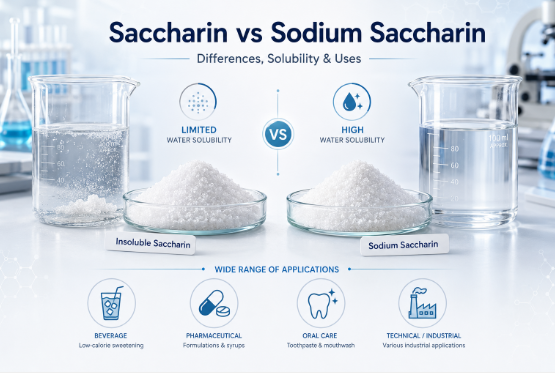
Saccharin and sodium saccharin are closely related sweetening ingredients, but they are not the same chemical form. Saccharin, often sold as insoluble saccharin, is the free acid form and has limited water solubility. Sodium saccharin is the sodium salt of saccharin and dissolves much more easily in water. This difference affects processing, formulation compatibility, typical applications and product selection.
For buyers and formulators, the choice should not be based only on sweetness. The required chemical form, dissolution speed, processing conditions, regulatory requirements and end use should all be considered.
Insoluble saccharin CAS 81-07-2 is the free acid form of saccharin. It is generally supplied as a white crystalline powder and is much less soluble in water than sodium saccharin.
The name “insoluble saccharin” does not mean that the material is completely unable to dissolve. A more accurate description is poorly or sparingly soluble in water. Because of this limited solubility, it may require longer mixing, pH adjustment or another validated processing method in water-based systems.
Sodium saccharin CAS 128-44-9 is the sodium salt of saccharin. It is normally supplied as white crystals or crystalline powder and is highly soluble in water. Its easier dissolution makes it more practical for beverages, syrups, pharmaceuticals, toothpaste, mouthwash and other aqueous formulations.
The main distinction is chemical form. Insoluble saccharin is the free acid, while sodium saccharin is produced when saccharin is neutralized with a sodium base.
| Comparison | Insoluble Saccharin | Sodium Saccharin |
| Chemical form | Free acid | Sodium salt |
| CAS number | 81-07-2 | 128-44-9 |
| Water solubility | Limited | High |
| Dissolution behavior | Slower and more formulation-dependent | Faster and easier in water |
| Typical use | Specialized or free-acid applications | Food, beverage, pharmaceutical, oral-care and technical uses |
| Processing | May require additional dispersion or adjustment | Usually easier to incorporate into aqueous systems |
| Direct substitution | Requires testing | Requires testing |
The two products should not automatically be substituted at the same weight. Differences in molecular form, assay basis, moisture and hydration can affect the required dosage and formulation behavior.
Saccharin and sodium saccharin share the same basic sweetening structure. Sodium saccharin is the salt form produced by reacting saccharin with an appropriate sodium base.
Saccharin free acid + sodium base → sodium saccharin
In water, sodium saccharin separates into ions more readily than the free acid dissolves. This is why sodium saccharin is generally preferred when rapid dissolution and uniform distribution are important.
The difference is therefore not that one is sweet and the other is not. Both provide the characteristic sweetness associated with saccharin. The practical difference is how their chemical forms affect:
Water compatibility
Dissolution speed
Processing requirements
Content uniformity
Sodium contribution
Finished-product performance
In some regulatory systems, saccharin and its sodium, potassium and calcium salts are grouped under the general category of saccharins. However, permitted uses and maximum levels still depend on the target country and product category.
Sodium saccharin is generally the more convenient option for liquid foods and beverages because it dissolves easily and distributes more evenly in water. It may be used in reduced-sugar drinks, syrups, confectionery, tabletop sweeteners, jams and other products requiring high-intensity sweetness.
Formulators should still test sweetness profile, aftertaste, flavor interaction and stability in the finished product.
Insoluble saccharin may be considered for selected dry or specialized systems. However, its limited solubility should be evaluated under actual processing conditions before commercial use.
Sodium saccharin is commonly used as a taste-masking excipient in oral products such as syrups, chewable tablets, lozenges and powders. Its high water solubility helps it disperse more evenly in liquid and fast-dissolving formulations.
Insoluble saccharin may be evaluated when the free acid form is specifically required or when a lower dissolution rate is useful. However, limited solubility alone should not be presented as proof of controlled-release performance.
Toothpaste and mouthwash manufacturers often need a non-sugar sweetener that can distribute uniformly in a water-based formulation. Sodium saccharin is usually preferred because it dissolves readily and can help balance the taste of surfactants, abrasives, flavors and other ingredients.
The final concentration should be determined through sensory and compatibility testing.
Saccharin compounds are also used outside food and personal care. Sodium saccharin may be added to nickel electroplating baths to influence deposit brightness, grain structure and coating properties.
Its performance depends on bath composition, pH, temperature, current density and other additives. Industrial users should therefore select the appropriate grade and dosage through process testing.
The most practical starting point is the formulation medium and required dissolution behavior.
| Application requirement | Recommended starting option | Main reason |
| Beverage or syrup | Sodium saccharin | Easier dissolution and uniform distribution |
| Liquid medicine | Sodium saccharin | Better fit for aqueous taste-masking systems |
| Toothpaste or mouthwash | Sodium saccharin | Good compatibility with water-based processing |
| Dry mix requiring fast dissolution | Sodium saccharin | Dissolves quickly after water is added |
| Formulation requiring the free acid | Insoluble saccharin | Provides the non-sodium chemical form |
| Specialized low-solubility system | Insoluble saccharin | Limited dissolution may suit specific requirements |
| Nickel electroplating | Application-tested grade | Performance depends on bath chemistry |
Before purchasing, buyers should confirm the exact chemical form, CAS number, assay, hydration state, moisture, solubility, product grade, packaging and compliance documents. Laboratory or pilot testing is recommended when changing supplier, grade or chemical form.
No. Saccharin is the free acid form, while sodium saccharin is its sodium salt. They share the same core structure but differ in solubility and processing behavior.
No. It is more accurately described as poorly or sparingly soluble in water.
Its ionic salt structure allows it to dissociate more readily in water than the neutral free acid form.
Sodium saccharin is usually the better starting option because it dissolves more easily and distributes more uniformly in liquid formulations.
Not without testing. Differences in chemical form, molecular weight, hydration and solubility may require dosage and process adjustments.
FortunaChem supplies both insoluble saccharin and sodium saccharin for different formulation and processing requirements.
Insoluble Saccharin, CAS 81-07-2: Suitable for buyers requiring the free acid form or evaluating specialized low-solubility applications.
Sodium Saccharin, CAS 128-44-9: Suitable for food, beverage, pharmaceutical, oral-care and selected technical applications requiring high water solubility.
Contact FortunaChem to request specifications, COA, TDS, SDS, packaging information, samples and application-based product selection support.
Popular Fortunachem Fine Chemical Products
Keeping you up-to-date with all the latest information, news, and events about Fortunachem!


Quick Links
Add:
E-mail:
 中文
中文
_phenylphosphinate主图.jpg "Chinese manufacturer high quality 99% Ethyl (2,4,6-trimethylbenzoyl) Phenylphosphinate/TPO-L CAS 84434-11-7")