 English
 Español
 français
 العربية
Search
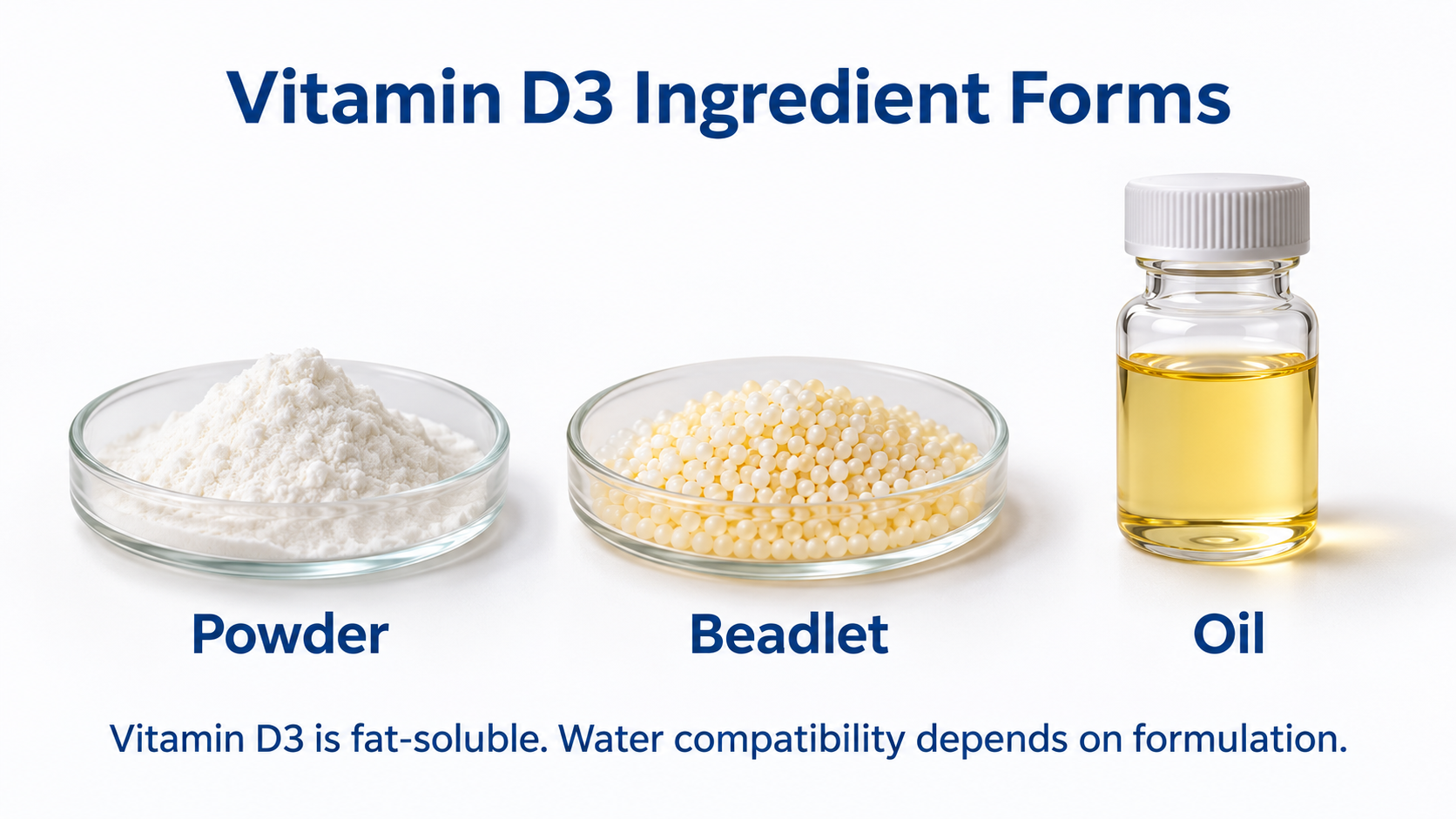
Vitamin D3 is fat-soluble and poorly soluble in water. Water-dispersible powders and beadlets allow it to be incorporated into water-based formulations, but the vitamin itself remains fat-soluble. Oil concentrates contain the same active ingredient in a different preparation.
This explains why vitamin D3 appears in products as different as fortified drinks, tablets and softgels. For manufacturers, the practical question is how a particular D3 preparation behaves during mixing, processing and storage. Understanding the difference between solubility, dispersion and potency makes choosing that preparation much easier.
Vitamin D3, also known as cholecalciferol, is one of the main forms of vitamin D. The National Institutes of Health classifies vitamin D as a fat-soluble vitamin. Turning D3 into a powder does not change that property.
Formulation provides a way to carry the vitamin into an aqueous system. Encapsulation and emulsions are among the approaches used in vitamin D food fortification. The resulting preparation can mix into water even though the active ingredient has not become intrinsically water-soluble.
Three distinctions help explain what happens in the mixing vessel:
Solubility: whether the ingredient dissolves at the molecular level.
Dispersibility: whether droplets or particles can be distributed through the liquid.
Appearance: whether the resulting mixture is clear, cloudy or opaque.
These properties are related, but they are not interchangeable. An evenly dispersed preparation can still produce a cloudy mixture.
CWS commonly means “cold-water-soluble,” while CWD means “cold-water-dispersible.” In vitamin D3 ingredients, these descriptions refer to the formulated preparation and its behaviour in water.
A CWS powder contains more than cholecalciferol alone. Its carrier system helps the preparation mix into water. CWD beadlets also deliver the vitamin through a formulated particle designed for dispersion. The carrier and preparation method influence the result.
For a clear beverage, appearance is an essential part of grade selection. A dairy drink may already be opaque, making clarity a different concern. Both applications need suitable distribution of the vitamin, but they do not necessarily need the same preparation. The CWS or CWD designation is useful; the expected appearance and recommended mixing conditions complete the picture.
Powder, beadlet and oil describe the ingredient’s physical form. The number alongside the grade describes its potency. The specifications below show how the same amount of active D3 can be supplied in different preparations.
| Form | Grade | Vitamin D3 potency | D3 content per gram of preparation |
| Powder | 100 CWS | 100,000 IU/g | 2.5 mg/g |
| Powder | 500 CWS | 500,000 IU/g | 12.5 mg/g |
| Powder | 850 CWS | 850,000 IU/g | 21.25 mg/g |
| Beadlet | 100 CWD | 100,000 IU/g | 2.5 mg/g |
| Beadlet | 500 CWD | 500,000 IU/g | 12.5 mg/g |
| Beadlet | 850 CWD | 850,000 IU/g | 21.25 mg/g |
| Beadlet | 100 DC | 100,000 IU/g | 2.5 mg/g |
| Oil | 1 MIU/g | 1,000,000 IU/g | 25 mg/g |
| Oil | 2 MIU/g | 2,000,000 IU/g | 50 mg/g |
| Oil | 5 MIU/g | 5,000,000 IU/g | 125 mg/g |
One MIU means one million international units. These figures describe ingredient concentration, not a recommended intake.
A powder is a finely divided dry preparation. A beadlet carries D3 within a small formulated particle, while an oil concentrate supplies it in an oil-based preparation. Equal potency means equal vitamin activity per gram; it does not mean that the ingredients will handle or disperse in the same way.
The finished product provides a practical starting point. A drink needs a preparation that works in its liquid base. A tablet or capsule needs one suited to its dry formulation and manufacturing process.
Beverages and instant drinks: CWS powders and CWD beadlets offer options for incorporating D3 into water-based products. Match the grade to the required appearance and reconstitution conditions.
Tablets, hard-shell capsules and fortified foods: powder and beadlet grades are available for these applications. Potency, blending and handling requirements help narrow the choice.
Softgels and suitable oil-containing foods: oil concentrates are supplied for applications including softgels, fortification and sauces. Carrier oil and concentration are central to formulation.
Other applications for powder and beadlet preparations include dairy products, bakery products, cereals, nutrition bars and gummies. Suitability depends on the individual grade and recipe.
For example, an instant drink powder needs assessment after reconstitution, not just in its dry blend. A softgel formulation starts with a different set of requirements because the ingredient is incorporated into an oil-based fill. Physical form matters because it affects how D3 enters the production process.
IU/g expresses vitamin activity per gram of the supplied ingredient. It is not a percentage-purity statement.
FDA guidance gives the conversion 1 microgram of vitamin D3 = 40 IU. A preparation containing 100,000 IU/g therefore supplies 2.5 mg of D3 per gram. At 500,000 IU/g, the corresponding content is 12.5 mg/g; at 850,000 IU/g, it is 21.25 mg/g.
A higher-potency preparation supplies more D3 in a given weight of material. The formulation will consequently require a different addition rate to deliver the same vitamin content. Potency alone does not describe the carrier or predict dispersion.
Fortunachem offers food-grade vitamin D3 powder (CAS 67-97-0) with a minimum potency of 100,000 IU/g, supplied in 25 kg drums. For formulation calculations, use the applicable specification and batch certificate of analysis.
A water-dispersion trial is useful, but the finished recipe gives a more relevant result. Food-fortification research identifies the food matrix and processing conditions as important factors in vitamin D formulation performance and stability.
Build the trial around the actual application. For a drink, this means assessing the preparation in the intended beverage base. For a multivitamin blend, include the other vitamin raw materials so the assessment reflects the complete formulation.
Mixing: does the preparation disperse under the intended temperature, mixing time and order of addition?
Appearance and distribution: does the finished formula have the required appearance and consistent ingredient distribution?
Processing and storage: does testing support the planned production process, packaging and shelf life?
Record the grade, potency and preparation method with each result. If the recipe or process changes, those records make it easier to identify what needs reassessment.
Vitamin D3 remains fat-soluble whether supplied as powder, beadlets or oil. Formulation determines how the preparation can be incorporated into a product; potency determines how much vitamin activity each gram supplies.
When discussing a D3 requirement with Fortunachem, share the product type, preferred form, required potency and any carrier or dispersion requirements. A clear description of the application helps connect the ingredient specification with the work it needs to do.
Yes. Cholecalciferol is vitamin D3. Powder, beadlet and oil preparations contain the same active vitamin in different physical forms.
No. Powder describes the physical form. Water compatibility depends on the preparation’s carrier system and formulation. CWS and CWD grades are intended for use in water-based systems, with behaviour specific to the grade.
No. A dispersion can be cloudy or opaque. For clear drinks, establish the required appearance during formulation trials.
Neither form is universally better. Oil concentrates suit applications such as softgels, while formulated powders and beadlets provide options for dry products and water-based formulations.
Each gram of the preparation supplies 100,000 IU of vitamin D activity, equivalent to 2.5 mg of D3. This is an ingredient potency, not a recommended daily intake.
[1] National Institutes of Health, Office of Dietary Supplements. Vitamin D: Fact Sheet for Health Professionals.
[2] U.S. Food and Drug Administration. Converting Units of Measure for Folate, Niacin, and Vitamins A, D, and E on the Nutrition and Supplement Facts Labels.
[3] Lavelli V, D’Incecco P, Pellegrino L. Vitamin D Incorporation in Foods: Formulation Strategies, Stability, and Bioaccessibility as Affected by the Food Matrix. Foods. 2021;10(9):1989.

Quick Links
Add:
E-mail:
 中文