 English
  Español
  français
  العربية
 Search
Search
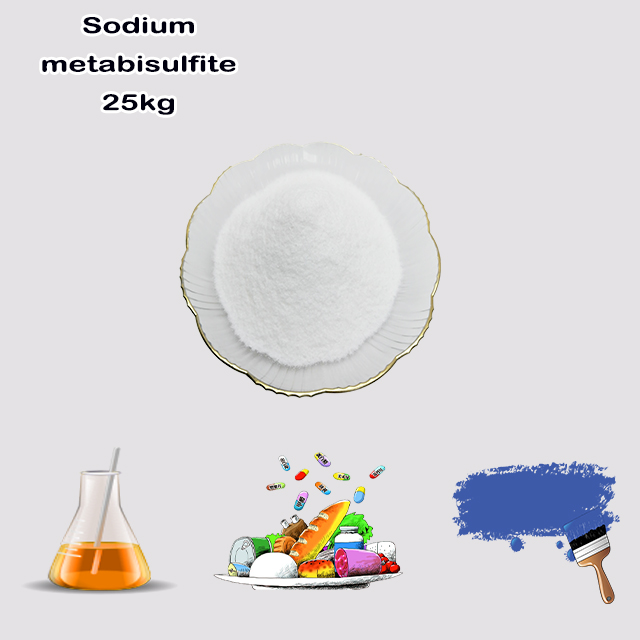
Sodium metabisulfite is used in the food industry as a bleach, preservative, slacker, antioxidant, and color protector. Sodium metabisulfite is used in the pharmaceutical industry in the production of chloroform, phenylpropyl sulfone and benzaldehyde. Sodium metabisulfite is used as a coagulant in the rubber industry. Sodium metabisulfite is used in the printing and dyeing industry as a dechlorinating agent after bleaching cotton cloth and cotton cloth cooking aid. Sodium metabisulfite is used in leather treatment in the tanning industry, which can make leather soft, plump, tough, waterproof, bending and wear-resistant. It is used in the chemical industry to produce hydroxyvanillin, hydroxylamine hydrochloride, etc. It is used as a developer in the photosensitive industry, etc.
Items | Specifications | Results |
Characters | This product is a colorless to off-white crystalline or crystalline powder, readily soluble in water and slightly soluble in ethanol. | The off-white crystalline powder is readily soluble in water and slightly soluble in ethanol. |
Identification | The solution shows the reactions of sulfate identification (1) and (3) | Positive reaction |
This product shows a flame reaction with sodium salts | Conforms | |
PH | 3.5~5.0 | 4.1 |
Clarity and color | Clear and colorless | Clear and colorless |
chloride | NMT 0.05% | <0.05% |
thiosulfate | NMT 0.05% | <0.05% |
ferric salt | NMT 0.002% | <0.002% |
Heavy Metal | NMT 20 per million | <20 per milion |
arsenic salt | NMT0.0001% | <0.0001% |
bacterial endotoxin | <5EU/mg | <5EU/mg |
Total aerobic bacteria count | NMT103cfu/g | <10cfu/g |
Assay | NLT 95.0% | 97.3% |
Conclusion | The product conforms to the above specifications. | |
Welcome to inquire us to get the complete COA
| Product parameters | |
| Cas number: | 7681-57-4 |
| Appearance: | White or yellowish crystalline powder |
| Purity: | 96.5%min |
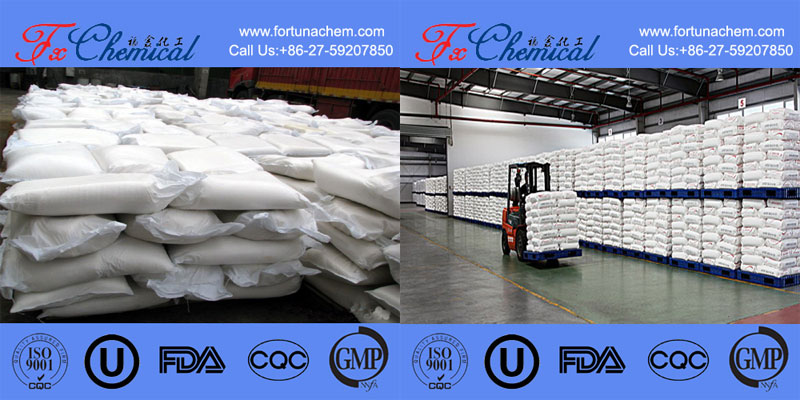
| Package details: | 25kg/bag; 50kg/bag |
| Brand: | Fortunachem |
Sodium metabisulfite (or sodium pyrosulfite) is an inorganic compound with the chemical formula Na₂S₂O₅. It is a white or yellowish-white crystalline powder with a sharp, pungent sulfur dioxide (SO₂) odor.
Key Chemical Behavior:
It is not stable in water and readily decomposes, releasing sulfur dioxide (SO₂). This property is the source of its usefulness.
It is widely used as a preservative, antioxidant, and bleaching agent.
Preservative: Inhibits the growth of bacteria, yeasts, and molds. Extends shelf life.
Antioxidant: Prevents browning (enzymatic and non-enzymatic) in fruits and vegetables. Used in:
Dried fruits (e.g., apricots, golden raisins)
Potato products (french fries, dehydrated potatoes)
Fruit juices, concentrates, and syrups
Wine and cider (see below)
Bleaching Agent: Used in the production of some sugars (like beet sugar) and maraschino cherries to achieve a bright color.
It is indispensable in these industries, where it is often referred to simply as "sulfites" or "campden tablets" (a tablet form).
Antimicrobial Agent: Kills or inhibits wild yeasts and bacteria, allowing cultivated yeast to ferment without competition.
Antioxidant: Protects wine from oxidation, which spoils color and flavor (prevents "browning" of white wines).
Stabilizer: Halts fermentation at a desired point and prevents refermentation in the bottle.
Equipment Sanitizer: Used to sanitize fermentation vessels, barrels, and bottles.
Antioxidant: Used as an excipient in some medications (injectable drugs, liquid formulations) to prevent the active ingredient from oxidizing and degrading.
Sterilizing Agent: For some equipment.
Dechlorination: Removes excess chlorine (and chloramines) from water. It is a common chemical for neutralizing chlorine in wastewater, in industrial processes, and even in home brewing (to make tap water safe for yeast).
Oxygen Scavenger: Used in boilers and oil recovery to remove dissolved oxygen, preventing corrosion.
Component of Developers and Fixers: Acts as a preservative to prevent oxidation of the developing agents.
Bleaching Agent: For wool, silk, and certain synthetic fibers.
Reducing Agent: In various chemical synthesis processes.
Waste Treatment: Neutralizes peroxide bleaches and removes heavy metals (e.g., chromium) from wastewater.
"Contains Sulfites" Warning: In many countries, foods and beverages containing more than 10 ppm SO₂ must carry this label.
Asthma Risk: A small subset of the population (particularly asthmatics, estimated ~3-10%) can have severe sulfite sensitivity, leading to breathing difficulties, wheezing, and in rare cases, anaphylaxis.
Generally Recognized as Safe (GRAS): For the vast majority of people, it is safe when consumed at regulated levels.
Irritant: Powder can irritate eyes, skin, and respiratory tract. Use in well-ventilated areas.
Toxic Gas Release: NEVER MIX WITH ACIDS (like vinegar, bleach, or hydrochloric acid). This mixture produces toxic sulfur dioxide gas, which can cause severe respiratory distress.
Corrosive to Metals: Releases SO₂ in moist air, which can corrode metals.
| Compound | Formula | Primary Use Context | Relationship |
|---|---|---|---|
| Sodium Metabisulfite | Na₂S₂O₅ | Versatile; food (E223), winemaking, water treatment, photography. Contains ~67% SO₂. | The most common solid source of SO₂; dissociates to bisulfite in solution. |
| Sodium Bisulfite | NaHSO₃ | Very similar to metabisulfite, often used interchangeably. Contains ~61% SO₂. | The form metabisulfite creates in water. Often a liquid solution in industry. |
| Sodium Sulfite | Na₂SO₃ | Paper pulping, water treatment, food preservative. | Releases less SO₂, more alkaline. |
| Potassium Metabisulfite | K₂S₂O₅ | Identical uses, especially in winemaking (preferred by some for potassium sensitivity). | Potassium version; used where sodium intake is a concern. |
Sodium metabisulfite is a versatile reducing agent, preservative, and antioxidant whose power comes from its controlled release of sulfur dioxide (SO₂). Its primary roles are:
Preserving Food & Drink: Preventing spoilage and browning.
Enabling Winemaking: As an antimicrobial and antioxidant.
Treating Water: As a dechlorinating agent.
Industrial Chemical: In textiles, photography, and as a reducing agent.
Its use is strictly regulated in food due to potential allergenic reactions in sensitive individuals, but it remains a critical and legal additive worldwide.
1.Food additive
2.Sanitization and cleaning agent
3.It is used in photography.
4.other uses


Fortunachem Provides Not Only Professional Chemical Products But Also Professional Help
Keeping you up-to-date with all the latest information, news, and events about Fortunachem!


Quick Links
Add:
E-mail:
 中文
中文