 English
  Español
  français
  العربية
  中文
中文
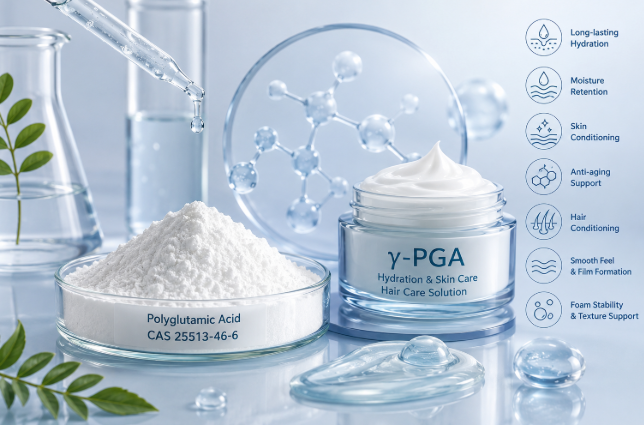
Polyglutamic acid is a water-soluble, film-forming biopolymer made from glutamic acid units and used in cosmetics mainly as a humectant, skin-conditioning and hair-conditioning ingredient.
For cosmetic formulators and raw material buyers who want to learn more about Polyglutamic acid specifications, CAS 25513-46-6, documentation and sourcing details, more information is available on the Polyglutamic acid product page.
Why Polyglutamic Acid Is Different from Exfoliating Acids
The word “acid” can easily create confusion in cosmetic marketing. Polyglutamic acid is not used in the same way as glycolic acid, lactic acid or salicylic acid. Those ingredients are often associated with exfoliation, peeling or pore care. Polyglutamic acid is mainly used for hydration, moisture retention, film formation and skin feel.
This makes γ-PGA especially suitable for products where the goal is comfort rather than irritation. It can be used in hydrating serums, creams, lotions, masks and selected hair care products. For brands building sensitive-skin, barrier-support or moisturizing concepts, Polyglutamic acid can provide a more elegant formulation story than simply adding another basic humectant.
A 2024 review published in Cosmetics describes poly-γ-glutamic acid as a multifunctional cosmetic ingredient with water solubility, biocompatibility and film-forming characteristics. The same review discusses its potential use in skincare, haircare, moisturizing formulations, conditioners, hydrating masks and depigmenting product concepts.
How γ-PGA Supports Long-Lasting Skin Hydration
Good hydration is not only about adding water to the skin. A strong moisturizing formula should help water stay where it is needed, improve comfort after application and reduce the feeling of tightness. Polyglutamic acid supports this by forming a smooth moisture-retaining film on the skin surface.
Cosmetics & Toiletries describes γ-PGA as a hydrophilic humectant that can form a smooth, elastic and self-moisturizing film on the skin surface, helping improve sensory perception and support the outer layer of the skin. This makes the ingredient especially useful for modern textures where consumers expect hydration without a heavy or greasy feel.
Polyglutamic acid is especially suitable for:
Hydrating serums designed for a smooth, lightweight and non-sticky finish.
Creams and lotions where film formation helps improve moisture retention.
Sheet masks and rinse-off masks that need strong water-binding and after-feel benefits.
Application Value in Skin Care Formulations
In skin care, Polyglutamic acid is often used as part of a broader moisturizing system. It can work alongside glycerin, hyaluronic acid, panthenol, betaine, ceramides, niacinamide and amino acid-based moisturizers. Its role is not necessarily to replace these ingredients, but to improve the hydration structure and sensory performance of the finished product.
For anti-aging concepts, γ-PGA is best described as a hydration-supporting ingredient. By helping skin retain moisture and improving surface smoothness, it may help reduce the appearance of dryness-related fine lines. This is a more responsible and conversion-friendly claim than saying that the ingredient “removes wrinkles.”
For brightening-oriented products, Polyglutamic acid can be positioned as a moisturizing support ingredient used together with brightening actives. In this role, it helps improve hydration, skin comfort and formulation completeness rather than acting as a single whitening solution.
| Cosmetic Product Type | Role of Polyglutamic Acid | Practical Formulation Benefit |
| Hydrating serum | Humectant and film former | Smooth finish and moisture-locking feel |
| Face cream | Skin-conditioning polymer | Better comfort for dry or tight skin |
| Sheet mask | Water-binding ingredient | Longer-lasting hydrated after-feel |
| Brightening lotion | Moisturizing support ingredient | Pairs well with brightening actives |
| After-sun gel | Hydration and comfort support | Helps reduce dryness and tightness |
| Barrier-support cream | Moisture-retention aid | Supports a smoother, more comfortable skin feel |
Why Molecular Weight Matters in Cosmetic Performance
Molecular weight can influence how Polyglutamic acid behaves in a finished formula. Lower-molecular-weight grades may be more relevant when the formulation focus is skin-conditioning activity and skin feel, while higher-molecular-weight grades may provide better film formation, foam stability and adsorption on hair.
This distinction is important for R&D teams because a facial serum, face cream, shampoo and conditioner may not need the same performance profile.
In practical formulation work, buyers may consider:
Lower-molecular-weight PGA for skin-conditioning concepts where sensory feel and activity are important.
Higher-molecular-weight PGA for film formation, foam stability and hair adsorption.
Specification testing when changing suppliers, because molecular weight distribution can affect viscosity, texture and performance.
How Polyglutamic Acid Supports Hair Care Products
Polyglutamic acid is not limited to skin care. It can also be used in hair care products where the formulation target is smoothness, softness, hydration and anti-static performance. In shampoos, conditioners, hair masks and leave-on treatments, γ-PGA can help improve the after-feel of the hair fiber.
For hair care brands, the best positioning is not “repairing all damage.” A more realistic direction is conditioning support, smoother after-feel, reduced static and hydration-focused hair care.
Hair care applications may include:
Moisturizing shampoos where foam feel and hair softness matter.
Conditioners designed to reduce static and improve smoothness.
Hair masks and leave-on treatments focused on softness, combability and hydration.
How Buyers Should Evaluate Polyglutamic Acid Suppliers
For cosmetic raw material buyers, sourcing Polyglutamic acid is not only about price. Product identity, CAS number, appearance, documentation, consistency and communication all matter before the ingredient enters formulation trials.
Buyers should confirm COA, TDS, MSDS, packaging, lead time and specification details before placing an order. They should also test the ingredient in the intended product format, because the same raw material may behave differently in a serum, cream, shampoo or conditioner system.
For buyers looking for a China-based chemical raw material partner, fortuna china can support sourcing, documentation and export communication for industrial ingredient projects.
Conclusion
Polyglutamic acid is a useful cosmetic biopolymer for hydration, film formation, skin-conditioning and hair-conditioning concepts. Its best value is not as a miracle anti-aging ingredient, but as a practical formulation tool that improves moisture feel and product performance. Buyers should evaluate molecular weight, documentation, solubility, sensory effect and supplier reliability before commercial use.
FAQ About Polyglutamic Acid in Cosmetics
Is Polyglutamic acid an exfoliating acid?
No. Polyglutamic acid is mainly used as a humectant and film-forming moisturizing ingredient. It is different from exfoliating acids such as glycolic acid, lactic acid and salicylic acid.
What skin care products can use Polyglutamic acid?
Polyglutamic acid can be used in hydrating serums, creams, lotions, sheet masks, rinse-off masks, after-sun gels and moisturizing brightening formulas. It is especially suitable for products focused on hydration, comfort and skin feel.
Can Polyglutamic acid be used in anti-aging products?
Yes. It can support anti-aging hydration concepts by improving moisture retention and helping reduce the appearance of dryness-related fine lines. Claims should remain cosmetic and should not suggest medical or permanent wrinkle removal effects.
Is high-molecular-weight PGA better than low-molecular-weight PGA?
Not always. Higher-molecular-weight PGA may be better for film formation, foam stability and hair adsorption, while lower-molecular-weight PGA may be more suitable for certain skin-conditioning concepts. The best choice depends on the final product format.
Can Polyglutamic acid be used in hair care?
Yes. It can be considered for shampoos, conditioners, hair masks and leave-on treatments. In hair care, it may help support smoother feel, reduced static, hydration and improved combability.