 English
  Español
  français
  العربية
 Search
Search
In modern cosmetic chemistry, formulators increasingly rely on multifunctional ingredients that can simplify formulations while improving product performance. One such widely used raw material is BTMS-50 (Docosyltrimethylammonium Methyl Sulphate).
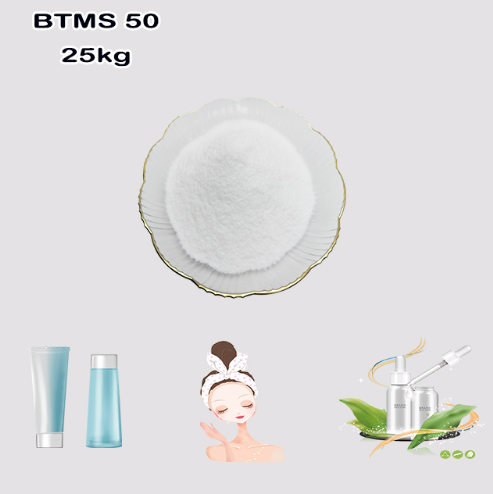
BTMS-50 is defined as a plant-derived cationic conditioning emulsifier composed primarily of behentrimonium methosulfate, cetearyl alcohol, and butylene glycol, designed to deliver hair conditioning, emulsification, and anti-static performance in cosmetic formulations.
It is commonly used in conditioners, hair masks, lotions, and skin care systems due to its ability to improve hair manageability while maintaining formulation stability.
BTMS-50 is not a single molecule but a functional blend system designed for cosmetic performance.
| Component | INCI Name | Function | Typical Percentage |
|---|---|---|---|
| Active conditioning agent | Behentrimonium Methosulfate | Hair conditioning, anti-static | 53–57% |
| Fatty alcohol | Cetearyl Alcohol | Thickening, emollient, structure builder | 30–35% |
| Solvent / humectant | Butylene Glycol | Solubility, moisture support | 5–10% |
According to supplier specifications, BTMS-50 typically shows:
Active content: ~55.2%
pH (1% solution): ~4.84
Appearance: white to pale yellow pellets
Stability range: suitable for emulsified cosmetic systems
This balanced structure explains why BTMS-50 functions as both an emulsifier and conditioning agent in one system.
BTMS-50 belongs to the cationic surfactant family, meaning it carries a positive charge. Hair fibers are naturally negatively charged, especially when damaged.
This charge attraction allows BTMS-50 to:
Bind to the hair surface efficiently
Reduce static electricity
Smooth cuticle layers
Improve combability
It also forms a thin conditioning film that improves softness without heavy buildup. At the same time, its fatty alcohol structure builds a lamellar emulsion network, helping oil and water phases remain stable. This dual-function mechanism is why it is widely considered a “self-emulsifying conditioning wax” in formulation science.
BTMS-50 is widely used in cosmetic manufacturing because it combines multiple performance roles into one ingredient.
| Function | Performance Effect |
|---|---|
| Conditioning agent | Improves softness and smoothness |
| Detangling agent | Enhances wet and dry combability |
| Anti-static agent | Reduces frizz and flyaways |
| Emulsifier | Stabilizes oil-water systems |
| Thickener | Improves viscosity and texture |
Its ability to provide both conditioning and emulsification reduces the need for multiple additives in formulation design.
BTMS-50 is especially important in hair care due to its performance on damaged and chemically treated hair.
Key reasons include:
Strong deposition on hair fibers
Long-lasting conditioning effect
Lightweight sensory profile
Compatibility with oils and silicones
Reduced formulation complexity
In conditioning systems such as masks and leave-in treatments, BTMS-50 provides a smooth, “slip” feel that improves user experience without leaving excessive residue.
Typical usage levels in formulations range from:
Hair conditioners: 2–8%
Hair masks: 3–10%
Shampoo systems: 0.1–0.5%
These ranges vary depending on formulation type and desired conditioning intensity.
BTMS-50 is widely used across personal care categories due to its multifunctionality.
| Product Category | Role of BTMS-50 |
|---|---|
| Hair conditioner | Primary conditioning emulsifier |
| Hair mask | Deep conditioning and repair support |
| Leave-in treatment | Anti-frizz and detangling |
| Shampoo systems | Mild conditioning during cleansing |
| Body lotion | Skin softening and emulsification |
| Body butter | Texture enhancement and stability |
Because of its gentle profile and plant-derived origin, BTMS-50 is frequently used in both hair care and skin care systems.
To understand BTMS-50’s value, it is useful to compare it with similar conditioning ingredients.
| Ingredient | Conditioning Strength | Build-up Risk | Emulsification Ability | Sensory Feel |
|---|---|---|---|---|
| BTMS-50 | High | Low | Strong | Silky, soft |
| BTMS-25 | Medium | Medium | Moderate | Slightly heavier |
| Cetrimonium chloride | High | Higher | Low | Light but less creamy |
| Nonionic emulsifiers | Low conditioning | Low | High | Neutral feel |
BTMS-50 is often preferred because it provides both emulsification and conditioning in a single system, reducing formulation complexity.
In global cosmetic raw material sourcing, BTMS-50 is typically supplied by cosmetic ingredient manufacturers specializing in fine chemical systems. It is widely distributed through fine chemicals and intermediates wholesale channels, where bulk quantities are provided for industrial formulation use.
Companies such as Fortuna China supply BTMS-50 as part of a broader portfolio of cosmetic raw materials for international markets.
From a formulation perspective, BTMS-50 offers several practical advantages:
Stable emulsions without additional emulsifier systems
Improved viscosity control
Reduced formulation steps
Compatible with most oils and emollients
Reliable batch-to-batch consistency
Its ability to simplify production makes it a preferred ingredient in large-scale cosmetic manufacturing.
BTMS-50 is widely used in rinse-off and leave-on cosmetic products. However, like all quaternary ammonium compounds, it should be used within recommended concentrations.
General formulation considerations include:
Avoid excessive dosage in leave-on products
Ensure proper emulsification during heating phase
Maintain pH within stable cosmetic range (commonly 4–7)
When used correctly, it is considered safe for cosmetic applications under standard industry guidelines.
BTMS-50 (Docosyltrimethylammonium Methyl Sulphate) is a multifunctional plant-derived conditioning emulsifier widely used in hair and skin care formulations. It improves hair softness, detangling, and anti-static performance while stabilizing emulsions in creams and conditioners. Its dual role reduces formulation complexity and enhances product performance. With strong compatibility in cosmetic systems and wide industrial availability through cosmetic ingredient manufacturers, BTMS-50 remains a core ingredient in modern personal care formulation design.
BTMS-50 is derived from plant-based raw materials such as rapeseed oil, but it undergoes chemical processing to become a functional conditioning emulsifier.
Typical usage ranges from 0.1% in shampoos to 10% in hair masks and conditioners, depending on the desired conditioning strength.
When used within cosmetic formulation limits, BTMS-50 is considered safe for rinse-off and leave-on products. Like all quaternary compounds, it should be handled according to formulation guidelines.
BTMS-50 is designed to minimize heavy buildup while providing conditioning benefits. Proper formulation prevents residue accumulation.
BTMS-50 is often marketed as plant-derived and biodegradable in certain formulations, though environmental impact depends on full product composition and disposal conditions.

Quick Links
Add:
E-mail:
 中文
中文