 English
  Español
  français
  العربية
  中文
中文
Polyglutamic acid is a water-soluble biopolymer composed of glutamic acid units that can help bind water, interact with nutrients and support root-zone delivery in agricultural formulations.
For fertilizer manufacturers, soil conditioner producers and agricultural formulation buyers who want to evaluate Polyglutamic acid in more detail, information about CAS 25513-46-6, product appearance, documents and supply options is available on the Polyglutamic acid product page.
Why Polyglutamic Acid Fits Agricultural Formulation Needs
In agriculture, Polyglutamic acid should not be positioned as a pesticide active ingredient. Its more accurate role is as a functional additive for soil conditioning, fertilizer efficiency and water-retention support.
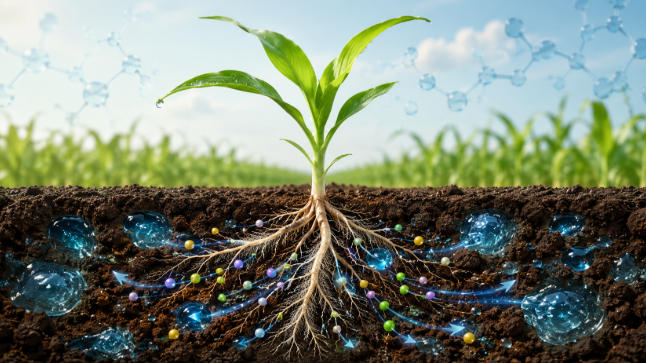
When γ-PGA is used in suitable soil or fertilizer systems, its hydrophilic structure helps improve the contact between water, nutrients and plant roots. In practical terms, it supports the microenvironment where root hairs absorb water and dissolved nutrients. This makes it useful for products designed around water-soluble fertilizers, specialty crop nutrition, soil amendments and root-zone performance.
Its agricultural value can be understood in three practical ways:
It helps retain moisture around the root area after irrigation or rainfall.
It supports closer contact between dissolved nutrients and plant root hairs.
It may help reduce nutrient loss caused by poor mobility, leaching or precipitation in soil.
How γ-PGA Supports Soil Moisture Retention
Soil moisture is not only about how much water is applied. It is also about how long that water remains available in the root zone. In sandy soils, dryland farming, greenhouse cultivation or areas with irregular irrigation, water may move away from the root area too quickly. This reduces the efficiency of both irrigation and fertilizer application.
γ-PGA has strong hydrophilicity, which means it can help hold water in the surrounding soil environment. When used as part of an agricultural formulation, it can support a more stable moisture condition around plant roots. This does not replace irrigation management, but it can help improve the way water is retained and used in the soil.
A field study published in Agricultural Water Management evaluated γ-PGA application rates of 0, 20, 40, 80 and 160 kg/ha during cotton-growing seasons in 2015 and 2016. The study reported improved soil water storage in the root zone, lower water consumption and better water-fertilizer productivity under the tested conditions. The authors calculated 65 kg/ha as an appropriate application strategy for the specific barren desertified soil conditions studied.
These numbers should not be copied as a universal dosage recommendation. Crop type, soil texture, irrigation method, regional climate and formula concentration all influence the final application design. However, the study provides a useful reference showing that γ-PGA is being evaluated in measurable agricultural systems rather than only described as a general water-retention polymer.
How Polyglutamic Acid Helps Nutrient Delivery
Fertilizer does not automatically become available nutrition after it enters the soil. Phosphorus, calcium, magnesium and trace elements may become less available due to soil pH, precipitation reactions or poor movement in the root zone. This is one reason fertilizer manufacturers look for additives that can improve nutrient availability and delivery.
Polyglutamic acid can support nutrient delivery by helping maintain better contact between fertilizer components, moisture and root hairs. In agricultural applications, γ-PGA hydrogel can form a thin protective film around plant root hairs, creating a more favorable platform for water and nutrient contact. It can also help reduce the precipitation of sulfate, phosphate and oxalate with metal elements, which may support better absorption of phosphorus, calcium, magnesium and trace elements.
Application Scenarios for Agricultural Buyers
Polyglutamic acid is most suitable when it is used in products that need water retention, nutrient delivery or root-zone support. The following table summarizes common agricultural application scenarios.
| Application Scenario | Role of Polyglutamic Acid | Buyer-Focused Value |
| Water-soluble fertilizer | Supports moisture and nutrient contact near roots | Improves fertilizer-efficiency positioning |
| Soil conditioner | Helps improve root-zone moisture retention | Supports soil water management concepts |
| Specialty crop nutrition | Improves nutrient delivery during key growth stages | Suitable for high-value crop formulations |
| Drought-prone farming | Helps maintain moisture around plant roots | Supports water-retention product development |
| Trace element formulation | May reduce precipitation of certain nutrients | Supports nutrient availability and absorption |
How to Position γ-PGA in Agricultural Products
For fertilizer brands, agricultural distributors and formulation manufacturers, the most effective content angle is not “miracle crop growth.” It is better to connect Polyglutamic acid with practical formulation needs: water retention, nutrient mobility, root-zone delivery and fertilizer efficiency.
Useful positioning directions include:
Polyglutamic acid for soil moisture retention and fertilizer-efficiency formulations.
γ-PGA as a functional biopolymer for root-zone nutrient delivery.
Polyglutamic acid for agricultural products focused on water and nutrient use efficiency.
What Buyers Should Check Before Sourcing Polyglutamic Acid
For agricultural formulation projects, Polyglutamic acid should be evaluated as a technical raw material. Buyers need to confirm not only the product name, but also documentation, physical properties, supply stability and suitability for the intended application.
Before placing an inquiry, buyers should check:
CAS number, product appearance, solubility and available specification range.
COA, TDS, MSDS, packaging information and export documentation.
Compatibility with the intended fertilizer, soil conditioner or crop nutrition formulation.
For buyers looking for a China-based chemical raw material partner, fortuna china can support sourcing, documentation and export communication for industrial ingredient projects.
Conclusion
Polyglutamic acid is not a pesticide active ingredient, but it can be a valuable agricultural formulation material for soil moisture retention, nutrient delivery and fertilizer-efficiency support. Its strongest commercial value is root-zone performance. Agricultural buyers should evaluate γ-PGA by specification, documentation, dosage design and crop application needs before using it in commercial products.
FAQ About Polyglutamic Acid in Agriculture
Is Polyglutamic acid a pesticide?
No. Polyglutamic acid is better positioned as a soil conditioner, fertilizer synergist or water-retention additive. It should not be described as a pesticide active ingredient unless a specific registered product and local regulatory approval support that claim.
How does γ-PGA improve fertilizer efficiency?
γ-PGA can help improve the contact between fertilizer nutrients, soil moisture and root hairs. It may also help reduce nutrient loss caused by precipitation or poor mobility, supporting better nutrient availability in the root zone.
Can Polyglutamic acid improve crop yield?
Some studies have reported yield-related benefits under specific conditions, but results depend on crop type, dosage, soil condition, irrigation and application method. It is more accurate to describe Polyglutamic acid as supporting water and nutrient use efficiency.
What agricultural products can use Polyglutamic acid?
It can be considered for water-soluble fertilizers, specialty crop nutrition products, soil conditioners, root-zone treatment products and agricultural formulations designed to improve water and nutrient use efficiency.
What documents should buyers request?
Buyers should request COA, TDS, MSDS, specification details, packaging information and any available formulation guidance before running trials or placing bulk orders.