 English
  Español
  français
  العربية
 Search
Search
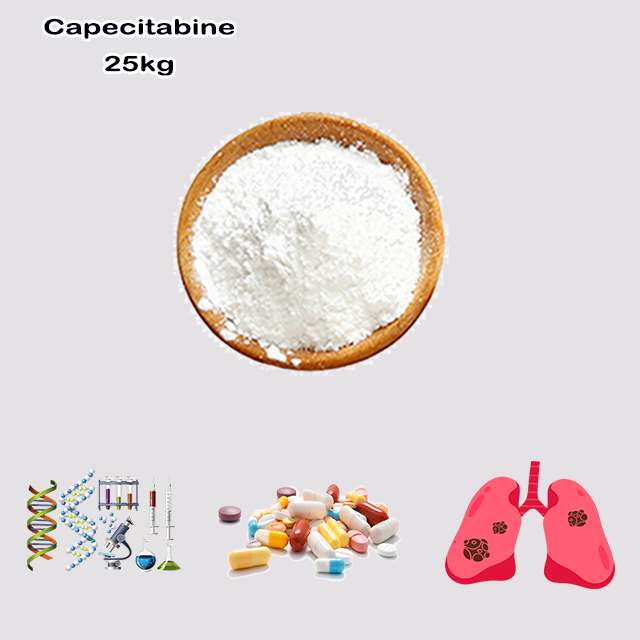




Capecitabine is mainly used to treat non-small cell lung cancer, pancreatic cancer, bladder cancer, breast cancer and other solid tumors.
Capecitabine is an antimetabolic fluoropyrimidine deoxynucleoside carbamate that can be converted to 5-FU in vivo, can inhibit cell division and interfere with RNA and protein synthesis, and is suitable for further treatment of advanced primary or metastatic breast cancer that does not respond to anthracycline chemotherapy regimens, mainly for the treatment of advanced primary or metastatic breast cancer, rectal, colon and gastric cancer.
| Items | Specifications | Results |
| Appearance | White to off-white powder | White powder |
| Individual unspecified impurity | ≤0.1% | 0.031% |
| Total unspecified impurities | ≤0.5% | 0.07% |
| Total impurities | ≤1.5% | 0.20% |
| Water | ≤0.3% | 0.04% |
| Residue on ignition | ≤0.1% | Conforms |
| Assay | 98.0%~102.0% | 99.60% |
| Product parameters | |
| Cas number: | 154361-50-9 |
| Appearance: | White to off-white powder |
| Purity: | 98~102% |
| Package details: | 1kg/foil bag; 25kg/fiber drum |
| Brand: | Fortunachem |
Capecitabine is an oral chemotherapy drug used to treat several types of cancer. It is most commonly known by the brand name Xeloda.
Capecitabine is what's known as a prodrug. This means it is inactive when you swallow it. Your body metabolizes it in a 3-step process, primarily in the liver and then within cancer cells, converting it into its active form: 5-Fluorouracil (5-FU).
Once activated, it works by:
Inhibiting Thymidylate Synthase: This is a key enzyme needed for DNA replication and repair.
Incorporating into RNA/DNA: It gets mistaken for normal building blocks and gets incorporated into RNA and DNA strands.
Both actions disrupt the cancer cell's ability to grow and divide, ultimately causing the cell to die.
Capecitabine is used to treat:
Colorectal Cancer: As adjuvant (post-surgery) therapy and for advanced or metastatic disease.
Breast Cancer: For metastatic breast cancer, often after other therapies have failed. It is also used in adjuvant settings for certain types of breast cancer.
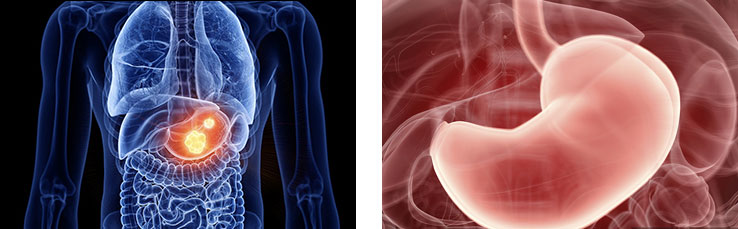
Gastric (Stomach) Cancer: For advanced cases.
It can be used alone or in combination with other chemotherapy drugs.
Common Side Effects: Include hand-foot syndrome (redness, pain, and peeling on palms/soles), diarrhea, nausea, vomiting, fatigue, and low blood cell counts.
Important Warning: Patients with a deficiency in the enzyme DPD (Dihydropyrimidine Dehydrogenase) are at high risk for severe, life-threatening toxicity from Capecitabine (and 5-FU). Testing for this deficiency may be done before starting treatment.
Administration: It is taken orally in cycles (e.g., two weeks on, one week off) to allow the body to recover.
In short, Capecitabine is a widely used oral chemotherapy that the body converts into an active anti-cancer drug, primarily to treat colorectal and breast cancers.




An antineoplastic agent. A prodrug of doxifluridine.

Fortunachem Provides Not Only Professional Chemical Products But Also Professional Help
Keeping you up-to-date with all the latest information, news, and events about Fortunachem!



Quick Links
Add:
E-mail:
 中文
中文