 English
  Español
  français
  العربية
 Search
Search
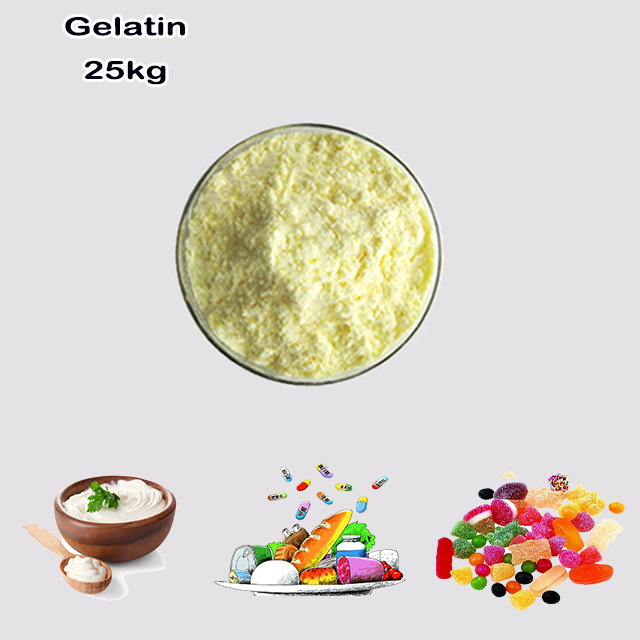
Gelatin is a low-calorie health food with high nutritional value, which can be used to make confectionery additives, frozen food additives, etc.
Gelatin has strong water absorption, high viscosity physical and chemical properties, coupled with a fat-free high protein, cholesterol-free, so gelatin has become a natural nutritional food thickener, for yogurt, jelly and other foods to add a certain taste and use, but also has a certain fresh-keeping effect. Gelatin is an important ingredient and additive in the food industry, often used as a gelling agent, stabilizer, emulsifier, thickener and clarifier in the production of meat products, cakes, ice cream, beer, juice, etc.
| Item | Specifications | Results |
| Appearance | Light yellow or yellow powder | Conform |
| Bloom | ≤50 | 25.6 |
| PH | 5.0 – 7.5 | 6.19 |
| Sq | ≤30mg/kg | 7.5 |
| Ash | ≤2.0 % | 1.0 % |
| Water | ≤15.0% | 12.15% |
| Appearance | Light yellow or yellow powder | Conform |
| Product parameters | |
| Cas number: | 9000-70-8 |
| Appearance: | Light yellow or yellow powder |
| Purity: | 99% |
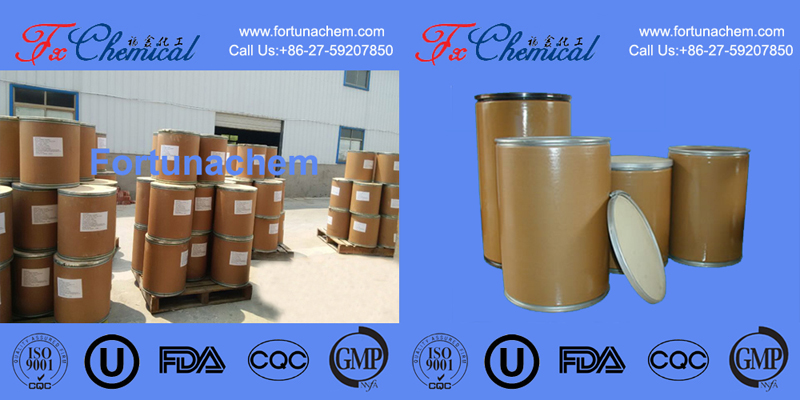
| Package details: | 25kg/drum |
| Brand: | Fortunachem |
Extraction: Obtained by boiling animal parts (like skin, bones, tendons, and ligaments) in water. This process breaks down collagen into gelatin through partial hydrolysis.
Processing: The extracted liquid is purified, concentrated, cooled, dried, and ground into a powder or sheets.
Composed of amino acids (like glycine, proline, and hydroxyproline) linked in long chains.
Not a complete protein (lacks essential amino acid tryptophan).
Gelling: Forms a thermo-reversible gel when cooled (e.g., Jell-O™). Melts around body temperature (35°C/95°F), giving it a smooth mouthfeel.
Thickening: Adds viscosity to liquids.
Stabilizing: Prevents ice crystal formation in frozen desserts (like ice cream) and foam collapse in whipped products (e.g., marshmallows).
Film-forming: Used in capsules (pharmaceuticals) and photographic film.
Food:
Gummy candies, marshmallows, desserts (jellies, panna cotta), yogurt, cream cheese, aspic, broths.
Clarifier in juices, wine, and vinegar (removes impurities).
Pharmaceuticals:
Capsules for pills and supplements.
Plasma expander in emergency medicine.
Cosmetics:
Thickener in shampoos, face masks, and lotions.
Industrial:
Photography (film coatings), adhesives, matches.
Non-vegetarian: Sourced from animals (not vegan/vegetarian).
Alternatives: Agar-agar (seaweed), pectin (fruit), carrageenan (algae), konjac, or vegan "gelatin" blends.
Religious Restrictions: Pork-derived gelatin may not be halal/kosher. Fish or beef-sourced options exist for compliance.
Allergies: Rare but possible (often linked to source animals).
Low in calories (∼35 kcal per tbsp).
Rich in glycine and proline (supports skin, joint, and gut health), but not a significant protein source.
Gelatin was first patented in 1845 by industrialist Peter Cooper, but it gained mass popularity when Pearle Wait added flavoring to create Jell-O in 1897!
In short: Gelatin is a versatile animal-derived protein used to gel, thicken, or stabilize countless products—from gummy bears to pill capsules—thanks to its unique collagen-based structure.
Guaranteed the purity
High quality & competitive price
Quality control
Fast feedback
Prompt shipment

Fortunachem Provides Not Only Professional Chemical Products But Also Professional Help
Keeping you up-to-date with all the latest information, news, and events about Fortunachem!

Quick Links
Add:
E-mail:
 中文
中文