 English
  Español
  français
  العربية
 Search
Search
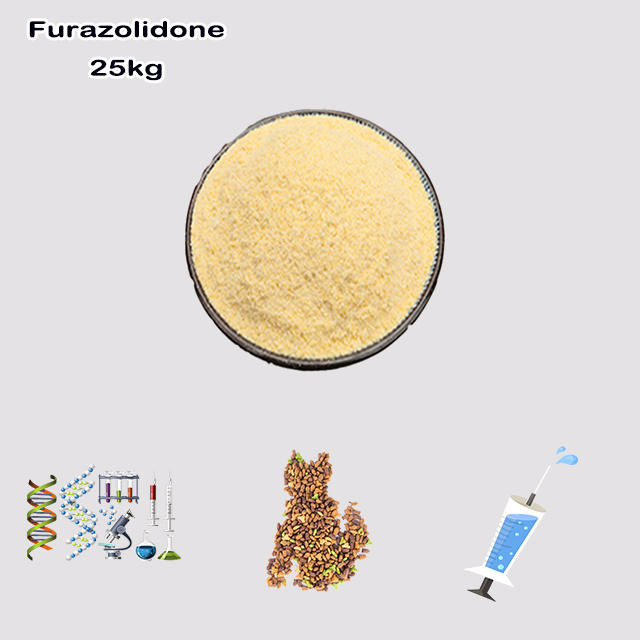



Furazolidone is a fungicide with a broad antibacterial spectrum. Furazolidone is effective against a variety of gram-positive and negative E. coli, Bacillus anthracis, Bacillus paratyphi, etc. Furazolidone is used to treat bacterial dysentery, enteritis, and also for vaginal infections.
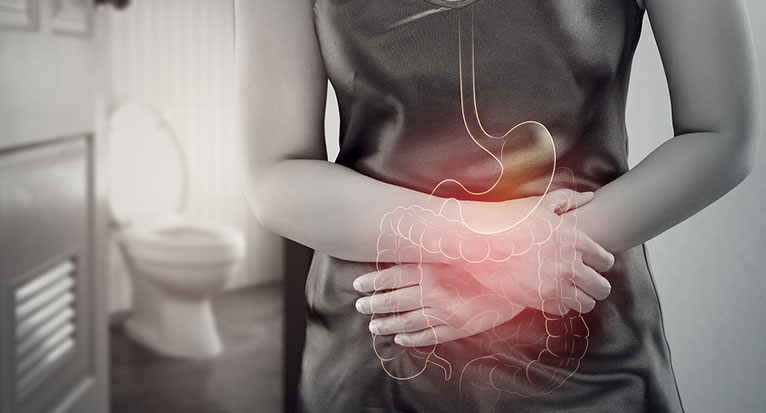
Furazolidone is mainly used for the treatment of various intestinal infections, bacterial dysentery, diarrhea, enteritis, Escherichia coli sepsis, typhoid fever, cholera, infectious rhinitis, blackhead, trichomoniasis, carinii leukocytosis, and can also be combined with antacids and other drugs to treat gastric sinusitis caused by Helicobacter pylori.
| Item | Specifications | Results |
| Appearance | Yellow crystalline powder | Conform |
| Residue on ignition | ≤0.25% | 0.08% |
| Loss on drying | ≤1.0% | 0.34% |
| Assay | 97.0% - 103.0% | 99.4% |
| Product parameters | |
| Cas number: | 67-45-8 |
| Appearance: | Yellow crystalline powder |
| Purity: | 97.0% - 103.0% |
| Package details: | 25kg/drum |
| Brand: | Fortunachem |
Its use in human medicine has declined significantly in many parts of the world due to safety concerns and the availability of better alternatives. However, it is still used in some countries and remains important in veterinary medicine.
Furazolidone's mechanism is complex and involves several pathways, which contributes to its effectiveness and low resistance rates:
Enzyme Inhibition: It is activated by bacterial enzymes and then interferes with several crucial bacterial biochemical pathways, including the Krebs (citric acid) cycle.
DNA Damage: The activated drug can cause damage to bacterial DNA.
Production of Toxic Metabolites: Its nitro group is reduced to highly reactive, toxic compounds that attack microbial cells.
This multi-pronged attack makes it difficult for bacteria to develop single-step resistance.
Furazolidone was primarily used to treat gastrointestinal infections caused by:
Bacteria: Such as E. coli, Salmonella, Shigella, Campylobacter, and Vibrio cholerae (cholera).
Protozoa: Most notably, Giardia lamblia (a common cause of infectious diarrhea).
It was particularly valued for its local action within the gut lumen, as it is poorly absorbed from the gastrointestinal tract.
It is still widely used in many countries to treat and prevent bacterial and protozoal infections in:
Poultry (e.g., for E. coli and Salmonella)
Pigs
Fish and Shrimp (in aquaculture)
The primary reason for the decline in Furazolidone's use in human medicine is its potential for toxicity.
Monoamine Oxidase Inhibition (MAOI):
This is a critical safety concern. Furazolidone is a monoamine oxidase inhibitor (MAOI).
MAOIs can cause a severe and dangerous rise in blood pressure (a hypertensive crisis) if the patient consumes foods rich in tyramine (e.g., aged cheeses, cured meats, fermented foods, tap beers, soy sauce) or takes certain medications (e.g., decongestants, certain antidepressants).
This MAOI effect can persist for several weeks after stopping the drug, requiring patients to continue dietary restrictions.
Carcinogenicity and Mutagenicity:
Nitrofuran drugs, including Furazolidone, have been shown to be carcinogenic (cancer-causing) and mutagenic (causing genetic mutations) in animal studies.
Due to this evidence, the use of Furazolidone and other nitrofurans in food-producing animals has been banned in the European Union, the United States, Canada, and many other countries. This is to prevent trace residues of the drug from entering the human food supply.
Other Side Effects:
Common side effects include nausea, vomiting, and headache.
A rare but serious side effect is hemolytic anemia in patients with a genetic deficiency in the enzyme glucose-6-phosphate dehydrogenase (G6PD).
Human Use: Not approved in the United States and the European Union. It may still be available in some countries in Asia, Africa, and Latin America.
Veterinary Use: Banned for use in food-producing animals in the EU, US, and many other nations due to cancer concerns. Its use is strictly monitored.
Class: A nitrofuran antibiotic.
Historical Use: Treating bacterial and protozoal gut infections like traveler's diarrhea and giardiasis.
Critical Safety Issue: It is a Monoamine Oxidase Inhibitor (MAOI), carrying a risk of dangerous food and drug interactions.
Major Concern: Classified as a carcinogen and mutagen, leading to its ban in food animals in most developed countries.
Current Status: Its use in human medicine is now very limited globally due to these safety profiles and the availability of safer alternatives (e.g., metronidazole for giardiasis, fluoroquinolones for bacterial diarrhea).
Disclaimer: This information is for educational purposes only. The use of Furazolidone is highly restricted and carries significant risks. It is absolutely essential to consult with a healthcare professional for any medical condition and not to self-medicate. This is not medical advice.




Guaranteed the purity
High quality & competitive price
Quality control
Fast feedback
Prompt shipment

Fortunachem Provides Not Only Professional Chemical Products But Also Professional Help
Keeping you up-to-date with all the latest information, news, and events about Fortunachem!



Quick Links
Add:
E-mail:
 中文
中文